

The State of the Furniture Industry in 2026: Performance, Digital Disruption & What Actually Works Today
The furniture industry in 2026 is defined by steady growth, digital transformation, and changing consumer expectations—not hype. Online channels are no longer “emerging”; they’re a foundational part of how people shop for furniture. At the same time, technology like 3D visualization and augmented reality (AR) is shifting from experimental to essential. Physical retail isn’t disappearing—it’s evolving into hybrid, experiential touchpoints that work hand‑in‑hand with digital.
Key Takeaways
- E‑commerce is essential: Online sales are a core revenue driver in both the US and Europe.
- Hybrid shopping dominates: Consumers mix online research with in-store experiences.
- 3D & AR visualization boosts confidence: Shoppers are more likely to buy and return less.
- Digital transformation is non-negotiable: Invest in 3D product modeling, AR, AI personalization.
- Mobile-first matters: Most furniture searches begin on mobile devices.
- Physical stores still matter: Experiential retail drives engagement and brand loyalty.
- Sustainability influences buying: Eco-friendly and transparent sourcing is increasingly valued.
- Actionable priorities: Focus on immersive visualization, omnichannel experiences, personalization, and scalable 3D content.
Furniture Market Growth & E‑Commerce Penetration
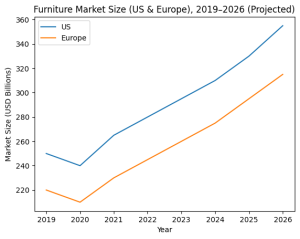
The furniture market continues to expand around the world, with North America and Europe as major contributors.
According to market research, the global furniture industry is projected to grow at a 4.3% CAGR through 2035, with the overall market value rising from about $437 billion in 2025 to $456 billion in 2026. North America accounts for roughly 28% of global market share and Europe about 26%—underscoring their ongoing importance. (source)
E‑Commerce Growth Is Real and Steady
Online furniture retail continues its rise:
- In the United States, online furniture sales now account for approximately 27% of total retail furniture sales as of 2025–2026. (source)
- Europe’s furniture e‑commerce market is expanding consistently, with countries like Germany, the UK, and France leading online adoption and logistics optimization. (source)
This isn’t a post‑pandemic blip—it’s the new baseline for furniture purchasing behavior.
Consumer Behavior: Confidence, Convenience & Digital Expectations
Digital Discovery & Mobile Behavior
Consumers are shopping differently:
- ~80% of Gen Z discover furniture brands via social media.
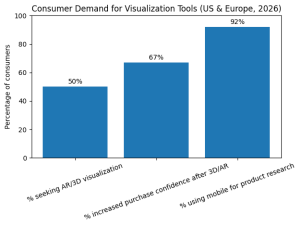
- ~60% of furniture shoppers use mobile devices for initial research.
(source)
Visual tools and immersive experiences are no longer “nice to have”—they shape purchase decisions:
- 3D and AR visualizations can increase conversion confidence dramatically and help reduce returns.
- Consumers who view furniture in 3D or AR are multiple times more likely to complete a purchase than those who don’t.
(source)
Hybrid Shopping is the Dominant Path
A 2025 study found that hybrid shopping—where consumers mix online research with in‑store visits—is now the most common furniture purchase journey. (source)
Highlights include:
- 45% of consumers use both digital and in‑store channels.
- Online‑only furniture shopping is growing while in‑store‑only declines.
- Shoppers increasingly expect 3D visualization support regardless of channel.
This signals that digital and physical aren’t competitors—they’re complementary.
Digital Transformation: Where the Industry Is Investing
Digital transformation isn’t optional anymore—it’s essential for competitiveness. Large majorities of furniture brands across the US and Europe are investing heavily in digital tools:
- 78% of furniture retailers have implemented digital transformation initiatives to enhance customer experience.
- 65% report increased online sales since investing in digital channels.
- 40% have integrated 3D modeling tools into product design or sales.
- 45% have adopted AR in their sales process.
(source)
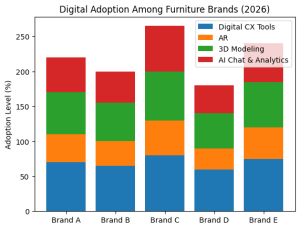
These aren’t experimental projects—these are strategic investments tied to measurable business outcomes.
What Digital Tools Are Driving Results in the Furniture Industry?
2026 is all about using the right technology to give customers confidence, reduce friction, and increase sales. Furniture brands that adopt the latest tools are outperforming competitors—especially those investing in 3D visualization, AR, and omnichannel solutions.
AI-Powered PersonalizationRecommends products based on behaviorIncreases average order value and cross-sell success
| Digital Tool | Why It Works | Benefits for Furniture Brands |
| 3D Product Modeling & Rendering | Creates lifelike representations of furniture online | Boosts engagement, lowers returns, supports customization |
| 360° Product Views | Lets shoppers explore every angle | Increases purchase confidence and time spent on product pages |
| VR & AR Visualization | Allows customers to “place” furniture in their own space | Reduces uncertainty, drives higher conversion rates |
| Product Configurators | Enable personalization and custom orders | Improves customer satisfaction, drives repeat purchases |
| Omnichannel Integration Tools | Connect online and offline experiences | Ensures consistency, seamless checkout, and higher loyalty |
Brands that adopt these tools don’t just keep up—they lead the market. Leveraging 3D product visualization, AR, and product configurators gives your customers confidence to buy, while reducing returns and boosting revenue.

Omnichannel & Physical Retail’s Transformation
Even in 2026, physical stores aren’t dead—they’ve evolved. Today, brick-and-mortar locations act as experiential hubs where customers can see, feel, and interact with products, complementing the online experience.
The key to success? Seamless integration between online and offline channels. Customers expect consistency: the same product availability, visualization, and customization options whether they’re browsing on mobile, desktop, or in-store.
| Strategy | How It Works | Benefits |
| Digital Showrooms | Use tablets, kiosks, or AR mirrors to display 3D product models and configurators | Customers explore multiple options without inventory limitations |
| Experiential Retail Spaces | Transform stores into interactive zones (“slowrooms”) with lifestyle setups | Drives engagement, encourages social sharing, and builds brand loyalty |
| Unified Online-Offline Inventory | Real-time stock and personalization visibility across channels | Reduces frustration and abandoned carts, improves customer trust |
| Interactive Consultations | In-store or virtual product specialists using 3D configurators | Helps customers design, customize, and purchase with confidence |

Omnichannel isn’t just a buzzword—it’s a competitive advantage. Brands that integrate 3D product visualization and configurators into both their online and in-store experiences win customer confidence, boost sales, and reduce returns.
Challenges Still Facing the Furniture Industry
The furniture industry is growing, but it’s not without hurdles. Rising costs, supply chain volatility, and changing consumer expectations continue to test brands in 2026. Here’s a clear breakdown:
| Key Challenge | Why It Matters | How Brands Can Respond |
| Inflation & Rising Costs | Material, manufacturing, and logistics costs fluctuate, squeezing margins | Optimize supply chain, consider dynamic pricing, offer value-driven products |
| Supply Chain Complexity | Global sourcing is risky; delays, tariffs, and shortages can impact inventory | Diversify suppliers, keep buffer stock, monitor logistics proactively |
| Shifting Consumer Expectations | Customers demand seamless omnichannel experiences, accurate product visualization, and customization | Implement 3D product visualization, AR tools, and online configurators |
| Digital Adoption Gaps | Brands slow to adopt tech risk losing market share to digitally advanced competitors | Invest in 3D modeling, AR, AI personalization, and scalable e-commerce content |
| Sustainability Pressure | Eco-conscious consumers increasingly expect transparency and sustainable materials | Highlight sustainable sourcing, eco-friendly materials, and lifecycle impact in marketing |
2026 rewards brands that are agile, digitally savvy, and proactive in addressing operational, technological, and consumer-driven challenges
What Furniture Brands Should Prioritize in 2026:
2026 isn’t the year to guess—it’s the year to invest in what drives measurable results. Furniture brands that focus on digital transformation, immersive visualization, and hybrid experiences are positioned to outperform competitors. Below is a practical guideline for key areas of focus.
| Priority Area | Why It Matters | Recommended Actions | How 3D Solutions Help |
| Immersive Visualization | Reduces returns, increases purchase confidence | Integrate 3D product modeling, AR previews, 360° product views | Customers can see and customize products in real time, boosting conversions |
| Omnichannel Experience | Consumers mix online and in-store; friction kills sales | Ensure seamless navigation across web, mobile, and physical touchpoints | 3D configurators unify digital & in-store visualization for consistent experiences |
| Mobile Optimization | Majority of research and early purchase decisions happen on mobile | Optimize website and checkout for mobile-first experience | Lightweight 3D viewers and responsive AR ensure fast, reliable performance |
| AI-Powered Personalization | Tailors recommendations and customer support | Use AI for product suggestions, chatbots, and dynamic pricing | Integrate 3D product previews in personalized recommendations for higher engagement |
| Sustainability & Transparency | Eco-conscious consumers demand clear sourcing & materials info | Highlight sustainability credentials and product lifecycle | 3D content can showcase material choices and eco-friendly options interactively |
| Content at Scale | Social media & omnichannel campaigns require fresh visuals | Produce 3D lifestyle imagery and product renders efficiently | Quickly generate photorealistic imagery for marketing campaigns without photography costs |
Conclusion: Lead the Furniture Market with Digital & 3D Innovation
The furniture market in 2026 rewards brands that move fast and think digitally first. Consumers expect seamless hybrid shopping experiences, confidence in their purchases, and tools to visualize products before committing—and brands that fail to deliver risk losing sales to competitors who do.
Investing in 3D product modeling, photorealistic 3D rendering, 360° product views, and 3D/AR configurators isn’t optional anymore—it’s the difference between thriving and falling behind. These tools increase engagement, boost conversions, and reduce returns, giving you a tangible advantage in a competitive market.
If you’re ready to modernize your product experience, scale customization, and wow customers without operational headaches, let’s talk. Our solutions make it simple to bring your furniture to life online, helping your brand stand out, sell more, and build loyalty. Let’s talk.
 Beds & Headboards furniture
 Chairs & Seating furniture
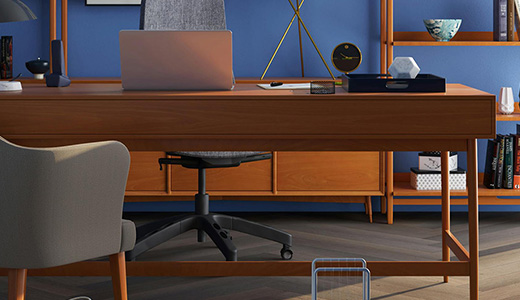 Tables & Desks furniture
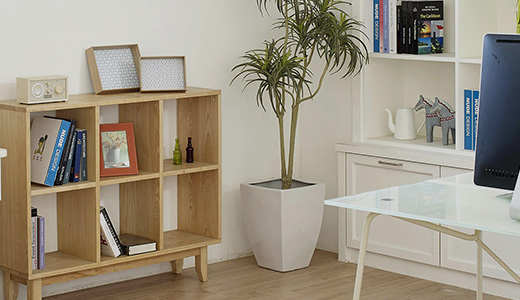 Storage & Organization furniture
 Sofas & Couches furniture