

Product Customization in Furniture: Definition, Benefits, and How to Implement It at Scale
Product customization is no longer a “nice-to-have” feature in the furniture industry. It has become a core expectation driven by modern e-commerce behavior, visual-first shopping, and rising customer demand for products that fit their space, style, and lifestyle.
Today’s furniture buyers expect to see, configure, and validate a product before it’s made—and they are willing to pay more for that confidence. In fact, 76% of consumers are willing to pay a premium for personalized furniture, making customization one of the strongest revenue and differentiation levers available to furniture brands.
The question is no longer whether to offer customization—but how to implement it efficiently, profitably, and at scale.
Key Takeaways
- Customization as Strategy: Product customization is a core revenue and differentiation driver in modern furniture e-commerce.
- Technology Enablement: 3D product modeling, rendering, and configurators are essential for scalable customization.
- Revenue Impact: Customized furniture can increase prices and AOV by up to 20%.
- Return Reduction: Accurate 3D visualization significantly lowers return rates.
- Customer Trust: Visual, interactive customization builds confidence and long-term brand loyalty.
What Is Product Customization?
Product customization is the process of adapting a product’s design, materials, dimensions, or features to meet individual customer preferences. In the furniture industry, this typically includes configurable options such as size, fabric, color, finishes, layout, and functional add-ons.
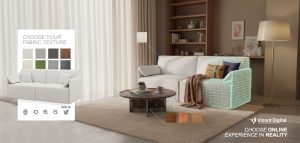
Unlike mass production, customization shifts value creation closer to the customer. When paired with 3D product modeling and 3D product rendering, customization becomes visual, interactive, and confidence-building—critical factors in online furniture sales.
Why Customization Matters More Today Than Ever
Furniture buyers now expect to see, configure, and validate a product before they commit. When they can’t, they don’t wait—they move on to a competitor that offers clearer customization and better visualization.
Several forces are accelerating this shift:
- E-commerce maturity: Shoppers expect the same control online that they’d get in a showroom.
- Visual-first decision-making: Static product images no longer answer enough questions for high-consideration purchases.
- Rising operational costs: Returns, rework, and customer service friction are increasingly expensive.
- Competitive benchmarking: Furniture brands offering configurators and 3D product visualization are setting the standard.
The reality is simple:
- Customization is expected.
- Poor customization loses sales.
If you’re modernizing your product experience or scaling customization without adding operational complexity, let’s talk.
Types of Product Customization in Furniture
Understanding the main customization models helps brands choose the right strategy for their product range, production setup, and target audience.
1. Make-to-Order (MTO)
Make-to-order customization means a product is manufactured only after the customer completes their configuration.
Best for: Sofas, beds, modular seating, premium furniture lines
Key advantages:
- Premium pricing and perceived exclusivity
- Reduced inventory and overproduction
- Better alignment with sustainability goals
When combined with photorealistic 3D product rendering, customers can confidently commit to a product that doesn’t yet exist physically.
2. Personalization Options
Personalization allows customers to modify predefined elements of an existing product—such as fabric, color, material, or finish.
Examples:
- Fabric and color selection
- Material swaps (wood, metal, leather)
- Engraving or labeling
This approach scales well and works especially effectively when supported by 3D furniture visualization and 360° product views, allowing customers to instantly preview their selections.
3. Design-Your-Own Products
Design-your-own sits between personalization and full MTO. Customers choose from controlled components (modules, sizes, layouts) rather than designing from scratch.
Why it works:
- Strong customer engagement
- Fewer production variables than full MTO
- Lower return rates due to expectation alignment
This model thrives when paired with product configurators that visually guide customers through valid combinations.
4. Variant Options and Add-Ons
Variant-based customization allows customers to select from predefined product versions and optional add-ons.
Examples:
- Size variants
- Leg styles
- Storage modules
- Accessories or functional upgrades
Clear UX and visual clarity are critical here. Without real-time 3D visualization, variant-heavy products quickly become confusing.
Customization Models at a Glance
| Customization Type | Customer Control | Operational Complexity | Best Use Case |
| Make-to-Order | Very high | High | Premium, modular furniture |
| Personalization | Medium | Low–medium | Scalable collections |
| Design-Your-Own | High (guided) | Medium | Modular systems |
| Variants & Add-ons | Low–medium | Low | High-volume SKUs |
The Business Benefits of Product Customization
1. A Better Online Shopping Experience
Customization turns passive browsing into active participation. When customers configure a product using 3D product rendering, they:
- Spend more time on product pages
- Feel more confident in their choices
- Abandon carts less frequently
Brands using visual configurators report return rate reductions of up to 40%, largely because customers know exactly what they’re buying.
2. Increased Revenue and Average Order Value
Customized furniture commands higher perceived value. On average:
- Customized products sell for up to 20% more
- Add-ons and upgrades increase AOV organically
- Customers are less price-sensitive when control is involved
Customization shifts the conversation from price to fit.
3. Stronger Brand Loyalty and Differentiation
Personalized experiences build emotional connection. Research shows that 80% of loyal customers prefer brands offering customization.
Customization supported by high-quality 3D product modeling signals:
- Design competence
- Technical sophistication
- Customer-centric thinking
4. Better Post-Purchase Satisfaction
When expectations match reality, satisfaction rises. Accurate 3D product visualization:
- Reduces buyer’s remorse
- Minimizes returns and complaints
- Encourages repeat purchases and referrals
Implementing Product Customization Successfully
Implementing product customization isn’t just a design decision—it’s an operational one. Success depends on aligning technology, user experience, and production logic so customers can customize with confidence while your business scales efficiently.
The most successful furniture brands treat customization as a system, not a feature. The table below outlines the core implementation pillars and what each one must deliver to ensure customization drives growth rather than complexity.
Core Pillars of Successful Product Customization
| Implementation Area | What It Requires | Why It Matters |
| E-commerce Platform & Integration | Support for complex product logic, pricing rules, and seamless integration with inventory and ERP systems | Prevents configuration errors, enables scalability, and ensures operational feasibility |
| 3D Product Visualization & Configurators | High-quality 3D product modeling, photorealistic 3D product rendering, real-time updates, and accurate materials | Builds buyer confidence, reduces returns, and increases conversion rates |
| User Experience (UX) | Intuitive flows, guided configuration, and prevention of invalid combinations | Reduces friction, cart abandonment, and customer confusion |
| Production & Data Readiness | Clean product data, manufacturing constraints embedded into the configurator | Ensures what customers design can actually be produced |
| Scalability & Future-Proofing | Modular setup, reusable 3D assets, and flexible configuration rules | Allows expansion across product lines without rework |
| Customer Feedback Loop | Continuous UX optimization using analytics, reviews, and behavioral data | Keeps customization aligned with real customer expectations |
Product Customization Tools: Why Configurators Are Mission-Critical
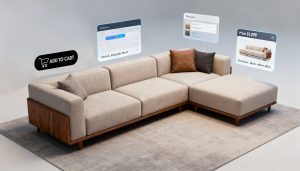
In modern furniture e-commerce, product configurators are not optional tools—they are the operational backbone of scalable customization. Without them, customization quickly becomes manual, error-prone, and commercially unsustainable.
A product configurator acts as the single source of truth between customer intent, visual validation, pricing logic, and production feasibility. It ensures customers can explore options freely while staying within constraints that your business and manufacturing processes can support.
When powered by accurate 3D product modeling and photorealistic 3D product rendering, configurators replace static product pages with interactive buying environments that mirror the in-store experience—and in many cases, outperform it.
What a Furniture Product Configurator Must Actually Do
| Capability | What It Enables | Business Impact |
| Real-Time 3D Visualization | Customers see every configuration change instantly | Higher conversion rates and fewer post-purchase surprises |
| Configuration Logic & Constraints | Prevents invalid size, material, or component combinations | Fewer production errors and customer service issues |
| Dynamic Pricing | Prices update as options change | Transparency and higher acceptance of premium pricing |
| Material & Finish Accuracy | True-to-life fabrics, textures, and lighting | Increased trust and reduced return rates |
| 360° Product Views | Full product inspection from every angle | Replaces physical showroom limitations |
| Data Output for Production | Structured configuration data passed to manufacturing | Faster order processing and reduced manual handling |
Why Configurators Drive Measurable Results
Furniture brands using configurators supported by high-quality 3D product rendering consistently report:
- Higher engagement time on product pages
- Increased average order value through guided upsells
- Lower return rates due to expectation alignment
- Reduced internal workload from fewer configuration errors
Just as importantly, configurators future-proof your product catalog. Once a robust 3D product modeling foundation is in place, adding new materials, modules, or variants becomes incremental—not a rebuild.
Configurators as a Trust-Building Mechanism
Customization introduces risk from the buyer’s perspective. Configurators eliminate that risk by letting customers validate their decisions visually before committing.
This is where static images fail and interactive 3D furniture visualization succeeds: it transforms customization from a leap of faith into a confident purchase.
In short, product configurators don’t just enable customization—they make it commercially viable at scale.
Customization as a Competitive Advantage
In today’s furniture market, customization isn’t a differentiator—execution is.
Most brands can offer options. Very few can deliver customization that is visual, accurate, scalable, and operationally sound. That gap is where competitive advantage is created.
Furniture brands that combine product configurators, high-fidelity 3D product modeling, and photorealistic 3D product rendering don’t just sell more—they sell with confidence. Customers understand what they’re buying, production receives clean, validated data, and returns drop as expectations align with reality.
Working with Vizard Digital is uncomplicated and professional. We were immediately impressed by the results of the 3D models, so we also use them for spatial visualization within our online shop. Many thanks to Vizard Digital and his team!

As customer expectations continue to rise, static product pages and limited variants will increasingly feel outdated. The brands that win are those that treat customization as infrastructure, not a feature—and invest in visualization systems that scale with their catalog and ambitions.
Customization done right doesn’t add complexity. It removes friction—for customers, for operations, and for growth.
Ready to bring your products to life with scalable customization? Let’s talk.
 Beds & Headboards furniture
 Chairs & Seating furniture
 Tables & Desks furniture
 Storage & Organization furniture
 Sofas & Couches furniture